

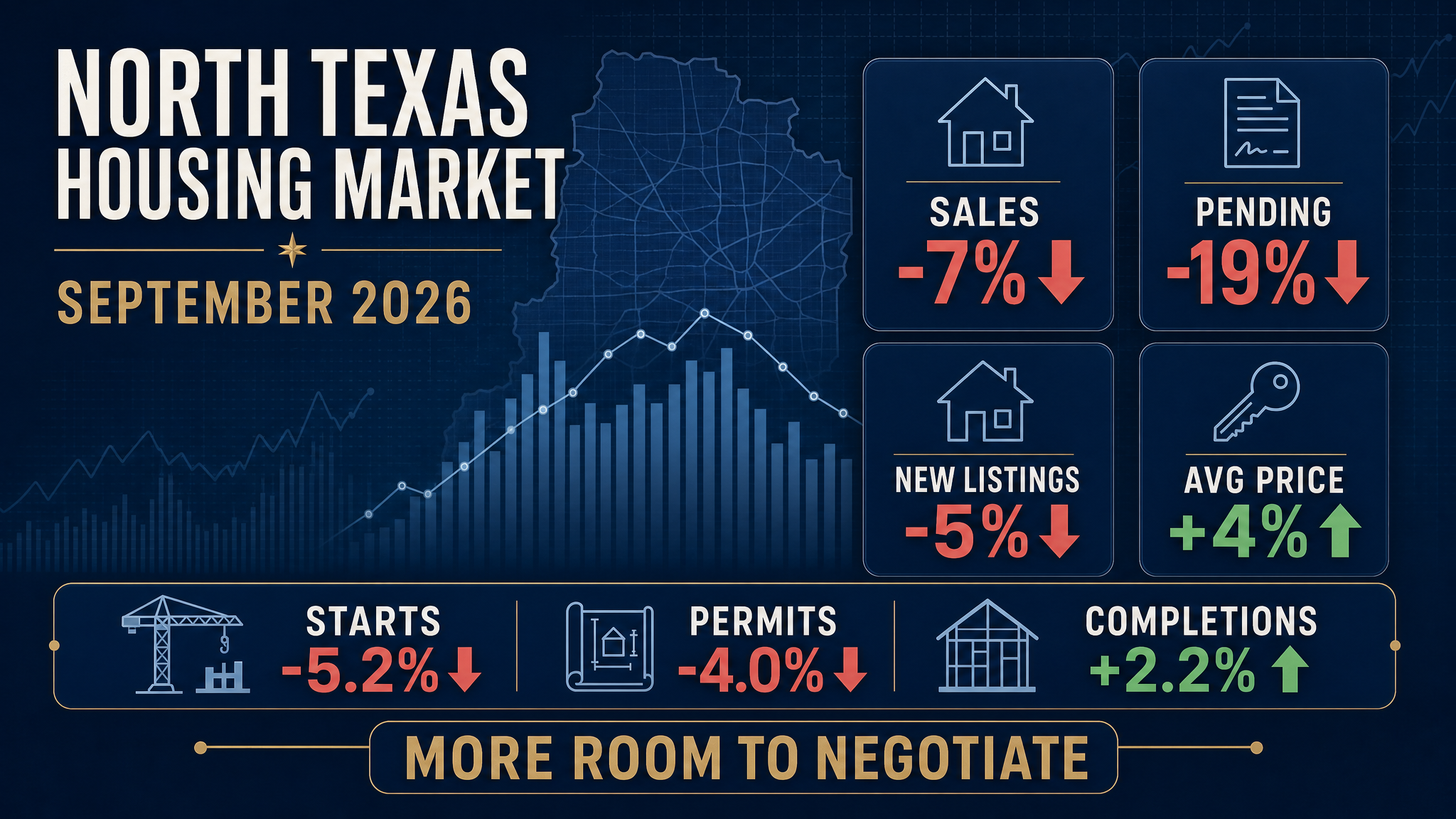
Housing headlines can make this market sound confusing. Existing-home sales rose slightly in September, yet pending contracts dropped sharply. Prices have held up in many places, while builders are slowing new starts. In North Texas, closed sales and new listings are lower than a year ago, even as the average sales price increased.
Those are not competing stories. They describe a market with fewer active buyers, more cautious sellers, and much more importance placed on the terms of a deal. Higher interest rates have made people careful, but they have also reduced the frantic competition that defined the last few years.
National demand is softer than the sales headline suggests
The National Association of REALTORS® reported that existing-home sales rose 1.5% in September to a 3.99 million annual pace. Sales were still 2.2% below September 2025. Pending home sales—the contracts that usually become future closings—fell 7.3% from August and 11.3% from a year earlier.
Inventory is giving buyers more room to operate. There were 1.60 million existing homes for sale nationally, up 4.6% from a year ago, equal to a 4.8-month supply. The typical home took 33 days to sell. A slower market does not automatically mean a market with falling prices; it means buyers have more time and more alternatives to compare.
Builders are becoming more selective too
Total housing starts fell 5.2% in September to a 1.221 million annual pace. Single-family starts dropped 4.6%, and single-family permits fell 4.0%. Housing completions, however, rose 2.2%.
That distinction matters. A slower pipeline does not mean no new-home opportunity. Builders with completed or nearly completed inventory may be especially motivated to offer a rate buydown, closing-cost help, upgrades, or other concessions instead of simply lowering a list price.
North Texas: the average price is not the whole story
The latest MetroTex Association of REALTORS® data shows 6,759 North Texas single-family home sales in September, down 7% from a year earlier. Pending sales fell 19% to 5,536, and new listings slipped 5% to 10,383. The market had 31,325 active listings and 4.3 months of inventory.
At the same time, the average sales price rose 4% to $509,534. The median price fell 1% to $385,000. That gap is important: an average-price increase can reflect a higher-priced mix of homes that sold; it does not mean every seller has more pricing power. The average sale-to-list price ratio was 93.9%, and homes averaged 62 days on market.
“The market is giving clear signs that negotiations are not just helpful right now—they are mandatory. Higher interest rates have made some buyers step back, which means there is less competition for buyers who are prepared to move. Sellers are often more willing to work not only on price, but on concessions, repairs, and terms that can make a real difference in the cost of a home. The right deal is not always the lowest price; it is the best overall package.”
Ty Williams, Broker/Owner, RJ Williams & Co.
Where a buyer’s leverage can show up
The opportunity is bigger than the sticker price. Depending on the home, seller, and local competition, leverage can show up through a seller-paid rate buydown, closing-cost credit, repair allowance, completed repairs, a home warranty, upgrades, or a closing timeline that makes the move easier.
That does not mean every seller will give everything away. A well-priced home in a strong location can still draw attention quickly. The advantage is that buyers can approach the process with more information, more time to compare, and a better chance to ask for terms that fit their budget instead of making rushed decisions.
What sellers should take from this
Sellers still have a path to a strong result, but the strategy has changed. Buyers can compare choices now. A seller who prices from current neighborhood-level comps, prepares the property well, and responds reasonably to a serious offer has a much better chance of protecting the final outcome.
Dallas-Fort Worth is not one market. Leverage in a first-time-buyer price range, a move-up neighborhood, a luxury community, or a new-construction subdivision can look very different. The best decisions come from reading the inventory, recent sales, and competing homes in the specific neighborhood and price range.
Bottom line
September’s data sends a clear message: fewer buyers are competing, inventory is giving buyers more choices, and sellers have more reason to negotiate. The market is not frozen. It is more deliberate—and that can be a strong environment for a prepared buyer to secure the best overall deal.
This article is for general real estate education and is not legal, financial, tax, lending, or investment advice. Sources: U.S. Census Bureau and HUD, New Residential Construction, September 2026; National Association of REALTORS®, Existing-Home Sales Increased 1.5% in September; CNBC housing-market coverage; and MetroTex Association of REALTORS®, September Housing Market Update.
Explore the full article archive
Browse more RJ Williams & Company articles on buyer strategy, seller guidance, broker responsibility, market updates, commercial real estate, land, investing, and new construction.